Class IX Math NCERT Solution for Circles 10.5
EXERCISE 10.5 (Page 184)
Q1. In the figure, A, B and C are three points on a circle with centre O such that ∠BOC = 30° and ∠AOS = 60°. If D is a point on the circle other than the arc ABC, find ∠ADC.
Sol: We have a circle with centre O, such that ∠AOB 60° and ∠BOC = 30°
∵ ∠AOB + ∠BOC = ∠AOC
∴ ∠AOC = 60° + 30° = 90°
Now, the arc ABC subtends ∠AOC = 90° at the centre and ∠ADC at a point D on the circle other than the arc ABC.

Q2. A chord of a circle is equal to the radius of the circle. Find the angle subtended by the chord at a point on the minor arc and also at a point on the major arc.
Sol: We have a circle having a chord AB equal to radius of the circle.
∴ AO = BO = AB

∴ ΔAOB is an equilateral triangle.
Since, each angle of an equilateral = 60°.
⇒ ∠AOB = 60°
Since, the arc ACB makes reflex ∠AOB = 360° – 60° = 300° at the centre of the circle and ∠ABC at a point on the minor arc of the circle.

Thus, the angle subtended by the chord on the minor arc = 150° and on the major arc = 30°.
Q3. In the figure, ∠PQR = 100°, where P, Q and R are points on a circle with centre O. Find ∠OPR.
Sol: The angle subtended by an arc of a circle at its centre is twice the angle subtended by the same arc at a point on the p circumference.

∴ reflex ∠POR = 2∠PQR
But ∠POR = 100°
∴ reflex ∠POR = 2 × 100° = 200°
Since, ∠POR + reflex = ∠POR = 360°
⇒ ∠POR + 200° = 360°
⇒ ∠POR = 360°
⇒ ∠POR = 360° – 200°
⇒ ∠POR = 160°
Since, OP = OR
∴ In ∠POR, ∠OPR = ∠OPR
Also, ∠OPR + ∠ORP + ∠POR = 180°
∠OPR + ∠ORP + 160° = 180°
2∠OPR = 180° – 160° = 20°

Q4. In the figure, ∠ABC = 69° ∠ACB 31°, find ∠BDC.

Sol: We have, in ΔABC,
∠ABC = 69° and ∠ACB = 31°
But ∠ABC + ∠ACB + ∠BAC = 180°
∴ 69° + 31° + ∠BAC = 180°
⇒ ∠BAC = 180° – 69° – 31° = 80°
Since, angles in the same segment are equal.
∴ ∠BAC = ∠BAC
⇒ ∠BDC = 80°
Q5. In the figure, A, B, C and D are four points on a circle. AC and BD intersect at a point E such that ∠BEC = 130° and ∠ECD = 20°.
Find ∠BAC.
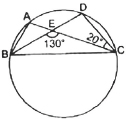
Sol: In ΔCDE,
Exterior ∠BEC = {Sum of interior opposite angles}
[BD is a straight line.]
130° = ∠EDC + ∠ECD
130° = ∠EDC + 20°
⇒ ∠EDC = 130° – 20° = 110°
⇒ ∠BDC = 110°
Since, angles in the same segment are equal.
∠BAC = ∠BDC
⇒ ∠BAC = 110°
Q6. ABCD is a cyclic quadrilateral whose diagonals intersect at a point E. If ∠DBC = 70°, ∠BAC is 30°, find ∠BCD. Further, if AB = BC, find ∠ECD.
Sol: ∵ Angles in teh same segment of a circle are equal.

∴ ∠BAC = ∠BDC
⇒ 30° = ∠BDC
Also ∠DBC = 70° [Given]
∴In ΔBCD, we have
∠BCD + ∠DBC + ∠CDB = 180° [Sum of angles of a triangle is 180°]
⇒ ∠BCD + 70° + 30° = 180°
⇒ ∠BCD = 180° – 70° – 30° = 80°
Now, in ΔABC,
AB = BC
⇒ ∠BCA = ∠BAC [Angles opposite to equal sides of a triangle are equal]
⇒∠BCA = 30°
Now, ∠BCA = ∠ECD = ∠BCD
⇒ 30° + ∠ECD = 80°
⇒ ∠ECD = 80° – 30° = 50°
Q7. If diagonals of a cyclic quadrilateral are diameters of the circle through the vertices of the quadrilateral, prove that it is a rectangle.
Sol: ∵AC and BD are diameters.
∴ AC = BD [∵All diameters of a circle are equal]

Since a diameter divides a circle into equal parts.
∠ABC = 90°
∠BCD = 90°
and ∠CDA = 90°
Now, in right ΔABC and right ΔBAD,
AC = BD [From (1)]
AB = AB [Common]
∴ ABC ≌ ΔBAD [RHS criterion]
⇒ BC = AD [c.p.c.t.]
Similarly, AB = CD
Thus, the cyclic quadrilateral ABCD is such that its opposite sides are equal and each of its angle is right angle.
Q8. If the nonparallel sides of a trapezium are equal, prove that it is cyclic. Solution: We have a trapezium ABCD such that AB || CD and AD = BC.
Let us draw BE || AD such that ABED is a parallelogram.

∵The opposite angles of a parallelogram are equal.
∴ ∠BAD = ∠BED ...(1)
and AD = BE [Opposite sides of a parallelogram] ...(2)
But AD = BC [Given] ...(3)
∴ From (2) and (3), we have
BE = BC
⇒ ∠BEC = ∠BCE [Angles opposite to equal sides of a triangle Δ are equal] ...(4)
Now, ∠BED + ∠BEC = 180° [Linear pairs]
⇒ ∠BAD + ∠BCE = 180° [Using (1) and (4)]
i.e. A pair of opposite angles of quadrilateral ABCD is 180°.
∴ ABCD is cyclic.
⇒ The trapezium ABCD is a cyclic.
Q9. Two circles intersect at two points B and C. Through B, two line segments ABD and PBQ are drawn to intersect the circles at A, D and P, Q respectively (see the figure). Prove that ∠ACP = ∠QCD.

Sol: Since angles in the same segment of a circle are equal.
∴ ∠ACP = ∠ABP ...(1)
Similarly, ∠QCD = ∠QBD ...(2)
Since ∠ABP = ∠QBD [Vertically opposite angles are equal]
From (1) and (2), we have
∠ACP = ∠QCD
Q10. If circles are drawn taking two sides of a triangle as diameters, prove that the point of intersection of these circles lie on the third side.
Sol: We have a ΔABC, and two circles described with diameters as AB and AC respectively. They intersect in a point D.

Let us join A and D.
AB is a diameter.
∴ ∠ADE is an angle formed in a semicircle.
⇒ ∠ADB = 90° ...(1)
Similarly, ∠ADC = 90° ...(2)
Adding (1) and (2), we have
∠ADB + ∠ADC = 90° + 90° = 180°
i.e. B, D and C are collinear points.
⇒ BC is a straight line.
Thus, D lies on BC.
Q11. ABC and ADC are two right triangles with common hypotenuse AC. Prove that ∠CAD = ∠CBD.
Sol: We have right ΔABC and right ΔADC such that they are having AC as their common hypotenuse.
∵ AC is a hypotenuse.

∵ ∠ADC = 90° = ∠ABC
∴ Both the triangles are in the same semicircle.
⇒ A, B, C and D are concyclic.
Let us join B and D.
∵ DC is a chord.
∴ ∠CAD and ∠CBD are formed in the same segment.
⇒ ∠CAD = ∠CBD.
Q12. Prove that a cyclic parallelogram is a rectangle.
Sol: We have a cyclic parallelogram ABCD.

Since, ABCD is a cyclic quadrilateral.
∴ Sum of its opposite angles = 180°
⇒∠A + ∠C = 180° ...(1)
But∠A = ∠C ...(2)
[Opposite angles of parallelogram are equal]
From (1) and (2), we have
∠A = ∠C = 90°
Similarly, ∠B = ∠D = 90°
⇒ Each angle of the parallelogram ABCD is of 90°.
Thus, ABCD is a rectangle.
EXERCISE 10.6 (Page 186)
Q1. Prove that the line of centres of two intersecting circles subtends equal angles at the two points of intersection.
Sol: We have two circles with centres O and O' respectively such that they intersect each other at P and Q. To prove that ∠OPO' = ∠OQO', let us join OP, O'P, OQ, O'Q and OO'.

In ΔOPO' and ΔOQO', we have
OP = OQ [Radii of the same circle]
O'P = O'Q [Radii of the same circle]
OO' = OO' [Common]
∴ Using the SSS criterion,
ΔOPO' ≌ ΔOQO'
∴ Their corresponding parts are equal.
Thus, ∠OPO' = ∠OQO'
Q2. Two chords AB and CD of lengths 5 cm and 11 cm respectively of a circle are parallel to each other and are on opposite sides of its centre. If the distance between AB and CD is 6 , find the radius of the circle.
Sol: We have a circle with centre O. (Chord AB) ∴∴ (Chord CD) and the perpendicular distance between AB and CD is 6 cm and AB = 5 cm, CD = 11 cm.
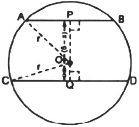
Let ‘r' be the radius of the circle.
Let us draw OP ⊥ AB and OQ ⊥ CD.
We join OA and OC.
Let OQ = x cm
∴ OP = (6 – x) cm [PQ = 6 cm
∵The perpendicular from the centre of a circle to chord bisects the chord.

Q3. The lengths of two parallel chords of a circle are 6 cm and 8 cm. If the smaller chord is at distance 4 cm from the centre, what is the distance of the other chord from the centre?
Sol: We have a circle with centre O. Parallel chords AB and CD are such that the smaller chord is 4 cm away from the centre.

Let us draw OP ⊥ AB and join
∴ OP ⊥ AB
∴ P is the mid-point of AB.

But we reject r = –5, because distance cannot be negative.

Again, in right ΔCQO, we have
OC2 = OQ2 + CQ2
⇒ r2 = OQ2 + 42
⇒ OQ2 = r2 – 42
⇒ OQ2 = 52 – 42 = 25 –16 = 9 [r = 5 cm]
The distance of the other chord (CD) from the centre is 3 cm.
Note: In case we take the two parallel chords on either side of the center, then
In ΔPOA, OA2 = OP2 + PA2
r2 = 42 + 32 = 52 = r = 5cm
In ΔQOC, OC2 = CQ2 + OQ2
⇒r2 = 42 + OQ2 ⇒OQ2 = 52 – 42 = 9
⇒OQ = 3cm
Q4. Let the vertex of an angle ABC be located outside a circle and let the sides of the angle intersect equal chords AD and CE with the circle. Prove that ∠ABC is equal to half the difference of the angles subtended by the chords AC and DE at the centre.

Sol: We have an ∠ABC such that the arms BA and BC on production, make two equal chords AD and CE. Let us join AC, DE and AE
An exterior angle of a triangle is equal to the sum of interior opposite angles.
∴In A BAE, we have
Exterior ∠DAE = ∠ABC + ∠AEC ...(1)
The chord DE, subtends ∠DOE at the centre and ∠DAE in the remaining part of the circle.


Q5. Prove that the circle drawn with any side of a rhombus as diameter, passes through the point of intersection of its diagonals.
Sol: We have a rhombus ABCD such that its diagonals AC and BD intersect at O.
Taking AB as diameter, a circle is drawn. Let us draw PQ || AD and RS || AB, both passing through O. P, Q, R and S are the mid-points of DC, AB, AD and BC respectively.

All the sides of a rhombus are equal.
∴ AB = DC

i.e. A circle drawn with Q as centre, will pass through A, B and O.
Thus, the circle passes through the point of intersection (O) of the diagonals of the rhombus ABCD.
Q6. ABCD is a parallelogram. The circle through A, B and C intersect CD (produced if necessary) at E.
Prove that AE, = AD.
Sol: We have a parallelogram ABCD. A circle passing through A, B and C is drawn such that it intersects CD at E.
∵ABCE is a cyclic quadrilateral.
∴∠AEC + ∠B = 180° ...(1)
[Opposite angles of a cyclic quadrilateral are supplementary]
But ABCD is a parallelogram.
∴ ∠D = LB ...(2)
[Opposite angles of a parallelogram are equal]

From (1) and (2), we have
∠AEC + ∠D = 180° ...(3)
But ∠AEC + ∠AED = 180° ...(4)
From (3) and (4), we have
∠D = ∠AED
i.e. The base angles of ∠ADE arc equal.
∴Opposite sides must be equal.
⇒ AD = AE
Q7. AC and BD are chords of a circle which bisect each other. Prove that (i) AC and BD are diameters, (ii) ABCD is a rectangle.
Sol: We have a circle with centre at O. Two chords AC and BD are such that they bisect each other. Let their point of intersection be O. Let us join AB, BC, CD and DA.

(i) To prove that AC and BD are the diameters of the circle.
In ΔAOB and ΔCOD, we have
AO = OC [∵ O is the mid-point of AC]
BO = DO [∵ O is the mid-point of BD]
∠AOB = ∠COD [Vertically opposite angles]
∴Using the SAS criterion of congruence,
ΔAOB ≌ ΔCOD
⇒AB = CD
⇒arc AB = arc CD
Similarly, arc AD = arc BC
Adding (1) and (2),
arc AB + arc AD = arc CD + arc BC
⇒BAD = BCD
⇒BD divides the circle into two equal parts.
∴BD is a diameter.
Similarly, AC is a diameter.
(ii) To prove that ABCD is a rectangle.
We have already proved that
ΔAOB ≌ΔCOD
⇒∠OAB = ∠OCD ⇒ ∠BAC = ∠ABD
⇒AB || CD
Similarly, AD || BC
∴ABCD is a parallelogram.
Since, opposite angles of a parallelogram are equal.
∴ ∠DAB = ∠DCB
But ∠DAB + ∠DCB = 180°
[Sum of the opposite angles of a cyclic quadrilateral is 180°]
⇒∠DAB = 90° = ∠DCB
Thus, ABCD is a rectangle.
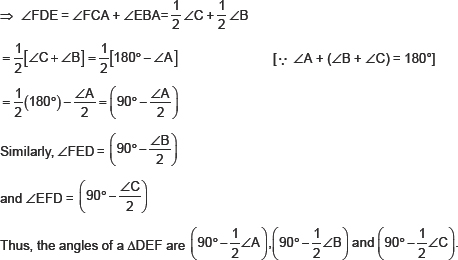
Q8. Bisectors of angles, A, B cmc! C of a triangle ABC intersect its circumcircle at D, E and F respectiveltively. Prove that the angles of the triangle DEF are 

Sol: We have a triangle ABC inscribed in a circle, such that bisectors of ∠A, ∠B and ∠C intersect the circumcircle at D, E and F respectively.
Let us join DE, EF and FD.
Angles in the same segment are equal.
∠FDA = ∠FCA ...(1)
∠FDA = ∠EBA ...(2)
Adding (1) and (2), we have
∠FDA + ∠EDA = ∠FCA + ∠EBA
Q9. Two congruent circles intersect each other at points A and B. Through A any line segment PAQ is drawn so that P, Q lie on the two circles. Prove that BP = BQ.
Sol: We have two congruent circles such that they intersect each other at A and B. A line passing through A, meets the circle at P and Q. Let us draw the common chord AB.

∵Angles subter.ded by equal chords in the congruent circles are equal.
∴ ∠APB = ∠AQB
Now, in ΔPBQ, we have
∠1 = ∠2
∴Their opposite sides must be equal.
⇒ PB = BQ
Q10. In any triangle ABC, if the angle bisector of ∠A and perpendicular bisector of BC intersect, prove that they intersect on the circumcircle of the triangle ABC.
Sol: We have a ΔABC inscribed in a circle. The internal bisector of ∠A and the bisector of BC intersect at E.

Let us join BE and CE.
∠BAE = ∠CAE
[AE is the bisector of ∠BAC]
∴ arc BE = arc EC
⇒ chord BE = chord EC
In ΔBDE and ΔCDE, we have
BE = CE
BD = CD [Given]
DE = DE [Common]
∴ By SSS criterion of congruence,
ΔBDE ≌ ΔCDE
⇒ Their corresponding parts are equal.
∴∠BDE = ∠CDE [Linear pairs]
But ∠BDE = ∠CDE = 180°
⇒∠BDE = ∠CDE = 90°
i.e. DE ⊥BC
Thus, DE is the perpendicular bisector of BC.


Comments
Post a Comment